
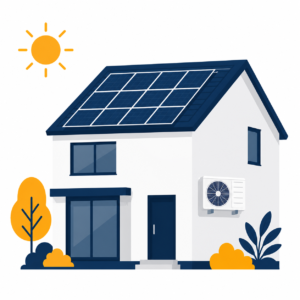
Air conditioning and solar panels UK households already have, or are planning, work well together for one straightforward reason: both peak at the same time. Solar generation is highest between 10am and 4pm on a sunny day, which is exactly when outdoor temperatures, and AC demand, are highest too. Run your AC during those hours and the electricity is close to free. The catch is that AC is usually needed most in the evening and overnight, when solar panels produce nothing at all. Whether the combination genuinely pays off depends on whether you also have a battery.
Get a free quote on solar panels and air conditioning
Tell us about your property and we will connect you with installers who can advise on both. No obligation.
Get a free quote on solar and air conditioningWhy solar and air conditioning are a natural combination
A standard UK residential solar array of 3 to 4kWp generates approximately 2 to 3.5kW during peak hours on a clear summer day. A 2.5kW air conditioning unit in cooling mode draws around 0.7kW of electricity at an EER of 3.5. During the middle of the day, a typical 4kWp array covers that AC load comfortably, with surplus left over to export or use elsewhere in the house.
In practical terms, this means that running air conditioning during daylight hours on a sunny day, if you already have solar panels, costs you close to nothing in marginal electricity terms. This is the genuine part of the pitch, and it holds up.
The honest limitation: what happens at night
The part most sales conversations skip over is that UK heatwave discomfort is mainly a sleep problem, not a daytime problem. The hours when air conditioning matters most for bedroom cooling are roughly 9pm to 6am, and solar panels produce nothing during that window. Without battery storage, overnight air conditioning runs entirely on grid electricity at the standard tariff rate.
At the current Ofgem price cap of 26.11p per kWh for 1 July to 30 September 2026, that overnight draw is not trivial. If you are weighing up whether solar makes air conditioning cheap to run, the honest answer is that it makes daytime running cheap. Overnight running is unaffected by having solar panels alone.
An installer selling you solar panels alongside air conditioning may present the two as automatically complementary. They are, for daytime use. They are not, by themselves, for the hours you are most likely to actually use the AC.
Battery storage: the piece that completes the picture
A home battery system stores surplus solar generation during the day and releases it in the evening and overnight. This is what closes the gap between when solar is generated and when air conditioning is actually needed.
A 10kWh battery has enough capacity to store surplus daytime solar and power a bedroom AC unit through the night. Overnight use of roughly 0.7kW for 8 hours works out at approximately 5.6kWh, well within a 10kWh battery’s range, with capacity left over for other household use.
Battery storage typically costs approximately £4,000 to £8,000 installed, depending on capacity and brand. Whether that cost is worth it depends on your own import and export tariffs and how many nights a year you would actually use the AC. That calculation is specific to your property and your energy contract, and it is not something this page can responsibly do for you. Model it against your own tariff before deciding.
What a combined installation looks like in practice
If you are planning solar and air conditioning at the same time, there is a practical advantage to getting a combined quote from a single installer rather than commissioning the two systems separately. An installer designing both together can size the battery around your expected AC load, and factor AC demand into the solar system specification from the start, rather than retrofitting one system around a battery sized for general household use alone.
The financial case: what it actually saves
Take a bedroom AC unit running 8 hours a night for 30 heatwave nights a year. That works out at approximately 168kWh of consumption (0.7kW multiplied by 8 hours multiplied by 30 nights). At the current Ofgem rate of 26.11p per kWh, that costs approximately £44 a year on grid electricity.
The same 168kWh drawn from stored solar instead costs closer to £0 to £10 a year, depending on your battery setup and export tariff. That is a real saving, but it is modest in absolute terms on its own. The stronger financial case for pairing solar with air conditioning is not the AC offset specifically. It is the broader reduction solar delivers across your total electricity use, of which AC is one part among many. Do not buy solar on the strength of the AC saving alone. Buy it, if you buy it, for the whole-house case, and treat the AC benefit as a welcome extra during the months you actually run the unit.
For a fuller breakdown of what air conditioning costs to run across a typical UK summer, see our guide to air conditioning running costs UK.
Smart controls: making the most of solar hours
Most modern AC units support app control or integration with Google Home or Amazon Alexa. If you already monitor your solar generation, you can use a smart plug or the unit’s own scheduling feature to run the AC automatically during peak generation hours rather than relying on remembering to switch it on. It is a small point, but it is free to set up and it directly increases how much of your AC use falls inside the free daytime window.
Final verdict
Solar and air conditioning genuinely work well together for daytime cooling. That part of the pitch is not overstated. What is often left out is that the hours you are most likely to actually want the AC, in the evening and overnight, fall outside what solar alone can cover. If you already have solar and are considering AC, run it during the day whenever you can and treat overnight running as a normal grid cost unless you also have a battery. If you are weighing up solar and battery storage as part of the same project, get a combined quote so the AC load is factored into the system design rather than added on afterwards. If you are also exploring a heat pump alongside solar, our guide to the air to air heat pump grant UK covers what BUS funding currently pays.
Get a free quote on solar panels and air conditioning
Tell us about your property and we will connect you with installers who can advise on both. No obligation.
Get a free quote on solar and air conditioningThis site earns a commission if you go on to purchase or enquire through links on this page, at no extra cost to you. We remain editorially independent.