
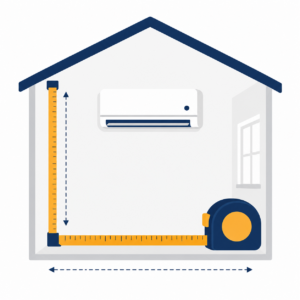
The right air conditioning unit size sits between two failure points. Undersized units run constantly without ever reaching your target temperature, working harder and using more electricity in the process. Oversized units cool the room quickly then shut off, a pattern called short-cycling that leaves the air feeling cold and clammy rather than properly cooled. Working out what size air conditioning unit do I need UK starts with a straightforward room size guide, then adjusting for things like glazing, insulation and ceiling height. A competent installer’s recommendation should land close to that figure, not the cheapest unit available.
Get a free quote from a local installer
Tell us about your property and we will connect you with MCS-certified installers in your area. No obligation.
Get a free air conditioning installation quoteWhy getting the size right matters: two things that go wrong
Most guidance treats sizing as a single mistake to avoid. It is actually two separate mistakes, and they show up differently.
Undersized: the unit that never quite gets there
An undersized unit runs almost continuously in warm weather because it can never fully close the gap between the room temperature and your target. It is not damaged by this, but it works harder for every degree of cooling it delivers, which shows up as higher running costs and faster wear over time. The problem is often invisible until the hottest days of the year, when the shortfall between what the unit can produce and what the room needs is at its widest. If a room never quite feels cool even with the unit running flat out, undersizing is the first thing to check.
Oversized: the unit that cools too fast
An oversized unit reaches the set temperature quickly and switches off, then switches back on again shortly after as the room warms. This is called short-cycling. The room drops in temperature fast but the unit never runs long enough in one cycle to remove much humidity from the air, so the result is a space that feels cold and damp rather than genuinely comfortable. Oversized units also draw more electricity per hour of operation than a correctly sized unit, and the constant stopping and starting causes more mechanical wear than steady running at a moderate load.
An installer who quotes a unit noticeably smaller than the room size guide below suggests may be cutting corners to offer a lower headline price. This is a known practice, and it is worth asking about directly rather than assuming the smaller number is simply more efficient.
A practical room size guide
These figures are a sanity check, not a substitute for a proper heat load calculation. Use them to see whether an installer’s recommendation is in a reasonable range before you ask further questions.
| Room type | Approximate floor area | Recommended unit size |
|---|---|---|
| Small bedroom | Up to 12m² | 1.5kW to 2.0kW |
| Standard bedroom | 12 to 18m² | 2.0kW to 2.5kW |
| Large bedroom or small living room | 18 to 25m² | 2.5kW to 3.5kW |
| Living room or open-plan kitchen-diner | 25 to 40m² | 3.5kW to 5.0kW |
| Large open-plan space | 40m² and above | 5.0kW and above, or multiple units |
| Conservatory | Add 20 to 30% to the equivalent room size above, due to higher solar gain | See adjusted figure |
All figures are approximate and based on general industry sizing practice as of Q2 2026. A formal heat load calculation carried out by the installer should be the final basis for specification, not this table alone.
If you see a figure in BTU rather than kW, divide by roughly 3,412 to convert to kW, or just ask the installer to quote in kW. A 2.5kW unit is approximately 8,500 BTU/h. Most UK installers now quote in kW, but older listings and some manufacturer spec sheets still use BTU.
What makes a room need a bigger unit
Factors that increase the size you need
- South or west-facing room with significant glazing
- A room under a poorly insulated roof, such as a loft conversion or top floor flat with a flat roof
- High ceilings above 2.5m, since heat stratifies upward and there is more volume to cool
- A conservatory or heavily glazed extension
- A home office with computers and monitors adding heat load
- High occupancy in the room
Factors that reduce the size you need
- North-facing room with limited direct sunlight
- Well-insulated room with good thermal mass
- External shading such as deep overhangs or deciduous trees to the south
- Ground floor room in a well-insulated property
How to check an installer’s recommendation
Use the table above to work out roughly what size air conditioning unit do I need UK for the room in question, then compare it to what the installer has quoted. If the quote is one size above the table figure, that is not automatically wrong. Ask whether a heat load calculation was carried out and which of the factors above pushed the recommendation up. A competent installer will explain this clearly and specifically to your room, not with a vague answer.
If the recommendation is noticeably below the table figure, ask the same question. Undersizing to offer a lower price on paper is a known way to make a quote look more competitive, and it is one of the things worth checking alongside the points covered in what questions to ask before accepting an AC quote. If you are still trying to work out whether the overall price is reasonable, our guide on air conditioning installation cost UK covers what a fair quote looks like.
A note on efficiency and inverter technology
It seems intuitive that a smaller unit running flat out would be more efficient than a larger one. In practice the opposite is often true. Modern inverter-driven units modulate their output to match demand rather than switching fully on and off, and they tend to run more efficiently at 50 to 60 percent of capacity than a smaller unit forced to run at 100 percent to achieve the same result. This is one of the reasons a slightly larger unit than the bare minimum calculation suggests is usually the right call, not just a way for an installer to sell a bigger system.
Final verdict
Start with the room size guide above, adjust for glazing, insulation, ceiling height and room use, and treat the result as your reference point. A quote that lands close to that adjusted figure, slightly above rather than at the bare minimum, is doing its job properly. Be more cautious of a quote that sits well below the guide than one that sits slightly above it. The unit that costs a little more upfront because it is sized correctly will usually cost less to run and last longer than the cheapest unit that technically fits the room.
Get a free quote from a local installer
Tell us about your property and we will connect you with MCS-certified installers in your area. No obligation.
Get a free air conditioning installation quoteThis site earns a commission if you go on to purchase or enquire through links on this page, at no extra cost to you. We remain editorially independent.