
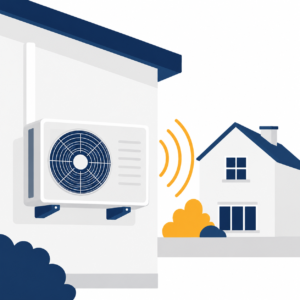
Two different worries sit behind most searches for air conditioning noise UK: how loud a unit will be before installing one, and what to do about a neighbour dispute once one is already running. Both come down to the same facts. A well installed modern split system is not a loud appliance: the indoor unit runs at roughly 19 to 35 dB(A) on its normal setting, similar to a quiet library. The outdoor condenser is louder and is what a neighbour might actually hear, and since May 2026 it must meet a binding limit under MCS 020: no more than 37 dB LAeq at the nearest habitable room of any neighbouring property.
Get a free quote from a local installer
Tell us about your property and we will connect you with MCS-certified installers in your area. No obligation.
Get a free air conditioning installation quoteHow loud is a split system air conditioning unit?
The part of the system indoors, the wall-mounted or ceiling unit blowing cool air into the room, is the quieter half by a wide margin. On its lowest fan setting a modern split system indoor unit typically runs at 19 to 35 dB(A). For reference, 30 dB is roughly the noise level of a quiet library, and 40 dB is a quiet room with normal background sound. On the highest fan speed some units reach 40 to 45 dB(A), noticeably louder but still well below anything most people would call disruptive during waking hours.
If sleep disturbance is a specific concern, ask any installer for the exact dB(A) rating of the proposed unit on its lowest setting, not a general marketing figure for the range. Manufacturers publish this and a proper quote should include it.
Most people stop noticing the indoor unit’s hum within a few nights once their ear adjusts to it, the same way a fridge or extractor fan fades into the background. If a unit feels intrusive from day one at its quietest setting, that is worth raising with the installer before accepting the quote, not after.
The outdoor condenser: where most of the noise comes from
The outdoor unit holds the compressor and fan, the two loudest components in the whole system. Typical output is 45 to 60 dB(A) measured at one metre from the unit, depending on the model and how hard it is working. To put that in context, 45 dB is comparable to a quiet conversation and 55 dB is closer to moderate rainfall or a normal conversation at a short distance.
The condenser does not run continuously. It cycles on and off to hold the set temperature, so the noise a neighbour experiences is intermittent rather than constant. Distance matters more than most buyers expect: at 5 to 10 metres from the unit, noise drops off sharply, and a condenser fitted to the rear of a property, away from the boundary, will typically be inaudible from inside a neighbour’s home at a normal installation distance.
The MCS 020 noise standard: what it means and why it matters
MCS 020 (a) is the sound calculation installers use to confirm a heat pump or air conditioning installation qualifies for permitted development rights rather than requiring a full planning application. From May 2026 it sets an overall limit of 37 dB LAeq, measured as an average over a five minute period rather than a single peak reading, at the nearest habitable room of any neighbouring noise-sensitive property. This replaced a previous 42 dB limit. If you have seen 42 dB quoted on another site, that figure is out of date.
Critically, this is not the same as the dB(A) at one metre figure discussed above. The 37 dB LAeq limit is a calculated result at the neighbour’s window, factoring in distance, any barriers or walls, and the unit’s sound power output, not a raw reading taken standing next to the condenser. A unit rated 55 dB(A) at one metre can still comfortably pass 37 dB LAeq at a neighbour’s window ten metres away with a wall in between.
In practical terms, 37 dB LAeq is quieter than a typical conversation and sits below the level most people would find intrusive in a garden or bedroom. A well specified, well positioned condenser from a reputable brand will usually meet this without difficulty. A large, budget-brand unit positioned close to a boundary in a quiet residential garden is the combination most likely to fail the calculation.
Being MCS certified as an installer does not automatically mean a specific installation meets MCS 020. The calculation has to be done for the actual proposed unit and siting on your property, not assumed from the installer’s general certification. Ask for the calculated result in writing before you accept a quote, not a verbal assurance that “it’ll be fine.”
Positioning your unit to minimise neighbour impact
Siting affects neighbour impact more than the unit’s price tag does. The quietest positions are generally the rear of the property, away from the boundary line, on a wall that does not face directly toward a neighbour’s bedroom or living room window. The positions most likely to cause problems are a side return tight against a boundary fence, the front of a property facing a neighbouring house, or anywhere close under a neighbour’s bedroom window.
A competent installer should model the noise impact of two or three possible siting options as part of the survey, before you commit to a position. If an installer proposes only one location without discussing alternatives, it is reasonable to ask why.
What to do if you have a noise dispute
If a neighbour raises a complaint after installation, the first step is establishing whether the unit actually exceeds the MCS 020 limit for that specific siting. An acoustic consultant can carry out an independent noise assessment. If the installation is within the limit, the complaint has no regulatory basis, even though a goodwill conversation about usage patterns, such as not running the unit overnight when the condenser sits close to a neighbour’s bedroom, can still help resolve friction informally.
If the assessment shows the unit exceeds the limit, responsibility sits with the installer to bring it into compliance. That might mean repositioning the unit, adding acoustic barriers or attenuation, or in more serious cases replacing the unit with a quieter model.
For a formal complaint, the relevant authority is the local authority’s environmental health team, who can investigate under the Environmental Protection Act 1990 if the noise amounts to a statutory nuisance. This is a high bar to meet. A unit that complies with MCS 020 would not typically be found to constitute a statutory nuisance, which is exactly why getting the calculation right before installation matters more than trying to fix a dispute afterwards.
Questions to ask before accepting a quote
Before signing off on any quote, ask the installer three specific things: the dB(A) rating of the proposed outdoor unit at one metre, whether the installation meets MCS 020 at 37 dB LAeq for your specific property and neighbours, and whether they have assessed the noise impact of the proposed siting rather than a generic assumption. For the full list of questions worth asking before accepting any air conditioning quote, see our guide to questions to ask before accepting a quote.
Final verdict
A properly specified and correctly sited split system will not be a noise problem for you or your neighbours. The indoor unit is quiet enough to ignore within a few nights, and the outdoor condenser, run through a genuine MCS 020 calculation for your actual property, should comfortably meet the 37 dB LAeq limit. Get the siting assessment in writing before installation rather than treating it as a formality, because that single document is what protects you if a dispute ever comes up later. If an installer cannot or will not provide it, treat that as a reason to get a second quote, not a detail to let slide.
Get a free quote from a local installer
Tell us about your property and we will connect you with MCS-certified installers in your area. No obligation.
Get a free air conditioning installation quoteThis site earns a commission if you go on to purchase or enquire through links on this page, at no extra cost to you. We remain editorially independent.